Abstract
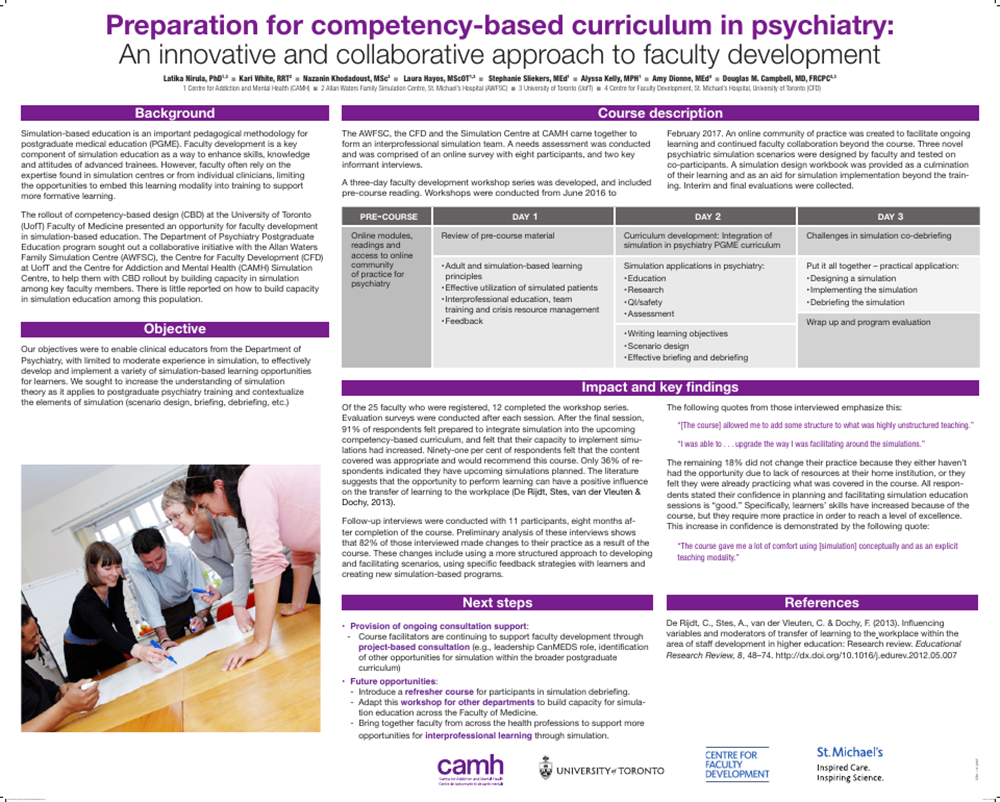
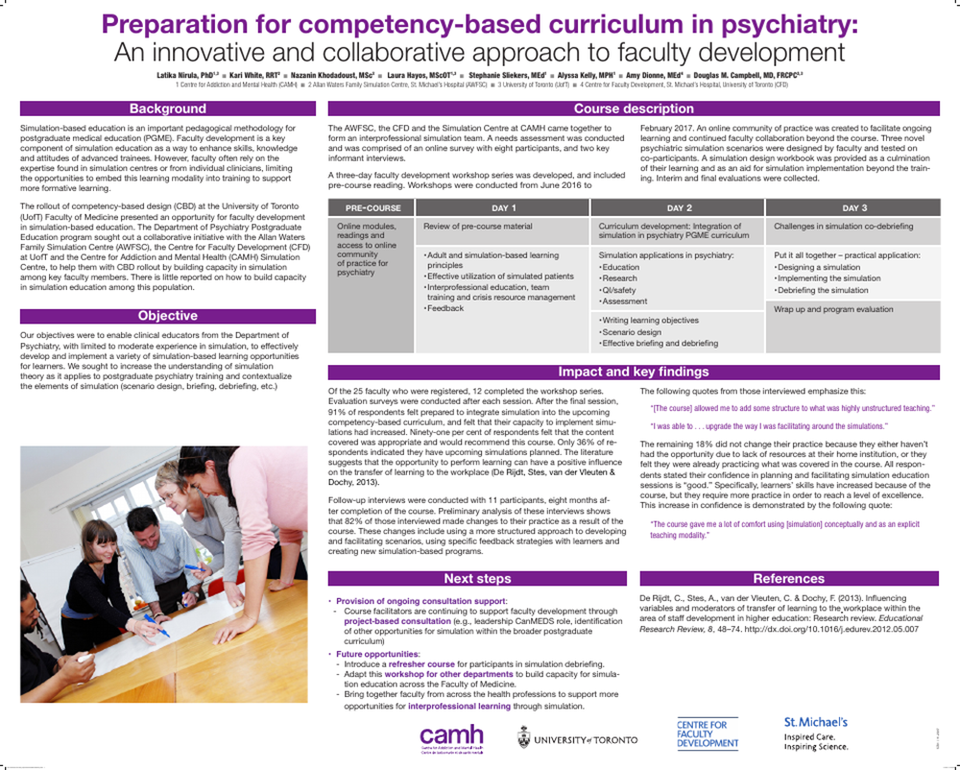
Background: The use of simulation has gained widespread acceptance into medical education. However, faculty expertise typically relies on expertise found in simulation centres or individual clinicians. The roll-out of competency-based design (CBD) at the University of Toronto Faculty of Medicine presented an opportunity. The Department of Psychiatry Postgraduate Education Program sought out a collaborative initiative to help them with CBD curriculum roll-out. Little is reported on how to impart simulation knowledge on a to such faculty.
Objective: Our objectives were to enable Clinical Educators from the Department of Psychiatry with limited experience in simulation to effectively: develop, implement and facilitate a variety of simulation‐based learning opportunities for learners. We sought to increase the understanding of simulation theory as it applies to postgraduate psychiatry training and contextualize the elements of simulation (scenario design, briefing, debriefing, etc.) in order to improve the training of psychiatric residents.
Description: The Allan Waters Family Simulation Centre, Centre of Faculty of Development and Simulation Centre at the Centre for Addiction and Mental Health, came together to form an interprofessional-leadership simulation team. A needs assessment was conducted through the use of a structured survey to the program director and faculty. A 3 day faculty development workshop was developed including pre-course reading. An online community of practice was created and participants were provided with a simulation design workbook. Workshops were conducted from June 2016 to February 2017. Interim and final evaluations were collected to gauge effectiveness of the workshop and overall impact.
Impact: Three novel psychiatric simulation scenarios were designed by faculty and tested on co-faculty including debriefing/analysis of debriefing, serving as a template for CBD curriculum roll-out.The vast majority of participants (91%) felt prepared to integrate simulation into the upcoming competency-based curriculum, and felt that their capacity to implement simulations has increased. 91% of respondents felt that the content covered was appropriate and would recommend this course. Only 36% of participants indicated they have upcoming simulations planned.
These results show that participants were satisfied, gained skills/materials from the collaborative, but may not have opportunities to apply learnings. A follow-up survey is planned in the next 3 months to further assess impact.