Abstract
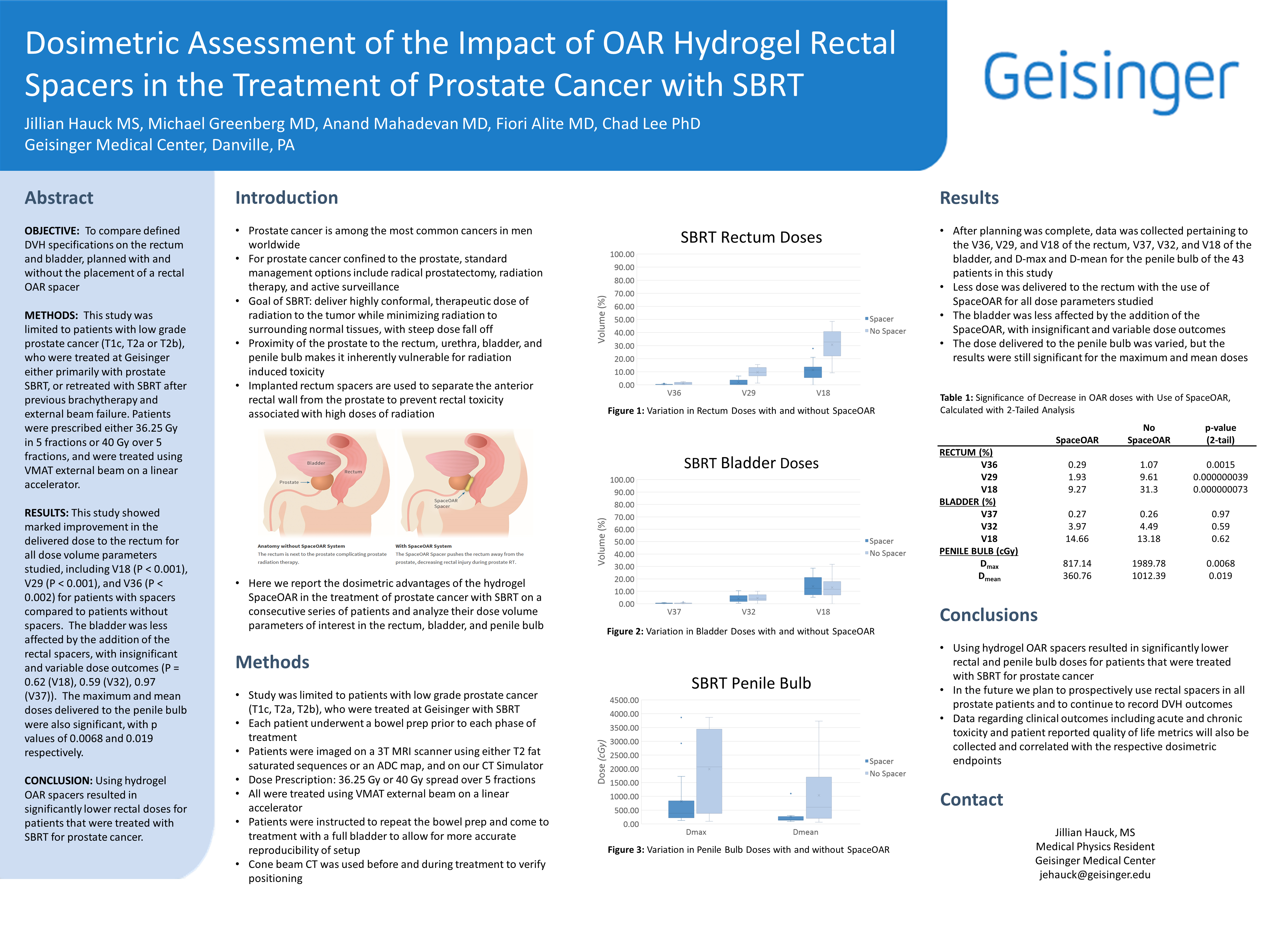
Objectives: To compare defined dose volume histogram specifications on the rectum and bladder, planned with and without the placement of a rectal organ at risk spacer.
Methods: This study was limited to 43 patients with low grade prostate cancer (T1c, T2a or T2b), who were treated at Geisinger either primarily with prostate SBRT, or retreated with SBRT after previous brachytherapy and external beam failure. All patients had fiducials placed at time of spaceOAR placement and were treated by the same radiation oncologist. They had bowel preparations and full bladders prior to simulation, and a urethrogram was performed at the time of simulation for enhanced urethral visualization. All patients were planned on a 3T MRI scanner using either T2 fat saturated sequences or an ADC map. Patients received either 36.25 Gy in 5 fractions or 40 Gy over 5 fractions. After planning was complete, data was collected pertaining to the V36, V29, and V18 of the rectum, V37, V32, and V18 of the bladder, and D-max and D-mean for the penile bulb.
Results: This study showed marked improvement in the delivered dose to the rectum for all dose volume parameters studied, including V18 (P < 0.001), V29 (P < 0.001), and V36 (P < 0.002) for patients with spacers compared to patients without spacers. The bladder was less affected by the addition of the rectal spacers, with insignificant and variable dose outcomes (P = 0.62 (V18), 0.59 (V32), 0.97 (V37)). The maximum and mean doses delivered to the penile bulb were also significant, with p values of 0.0068 and 0.019 respectively.
Conclusions: Using hydrogel OAR spacers resulted in significantly lower rectal and penile bulb doses for patients that were treated with SBRT for prostate cancer. In the future we plan to prospectively use rectal spacers in all prostate patients and to continue to record DVH outcomes. Data regarding clinical outcomes including acute and chronic toxicity and patient reported quality of life metrics will also be collected and correlated with the respective dosimetric endpoints.