Abstract
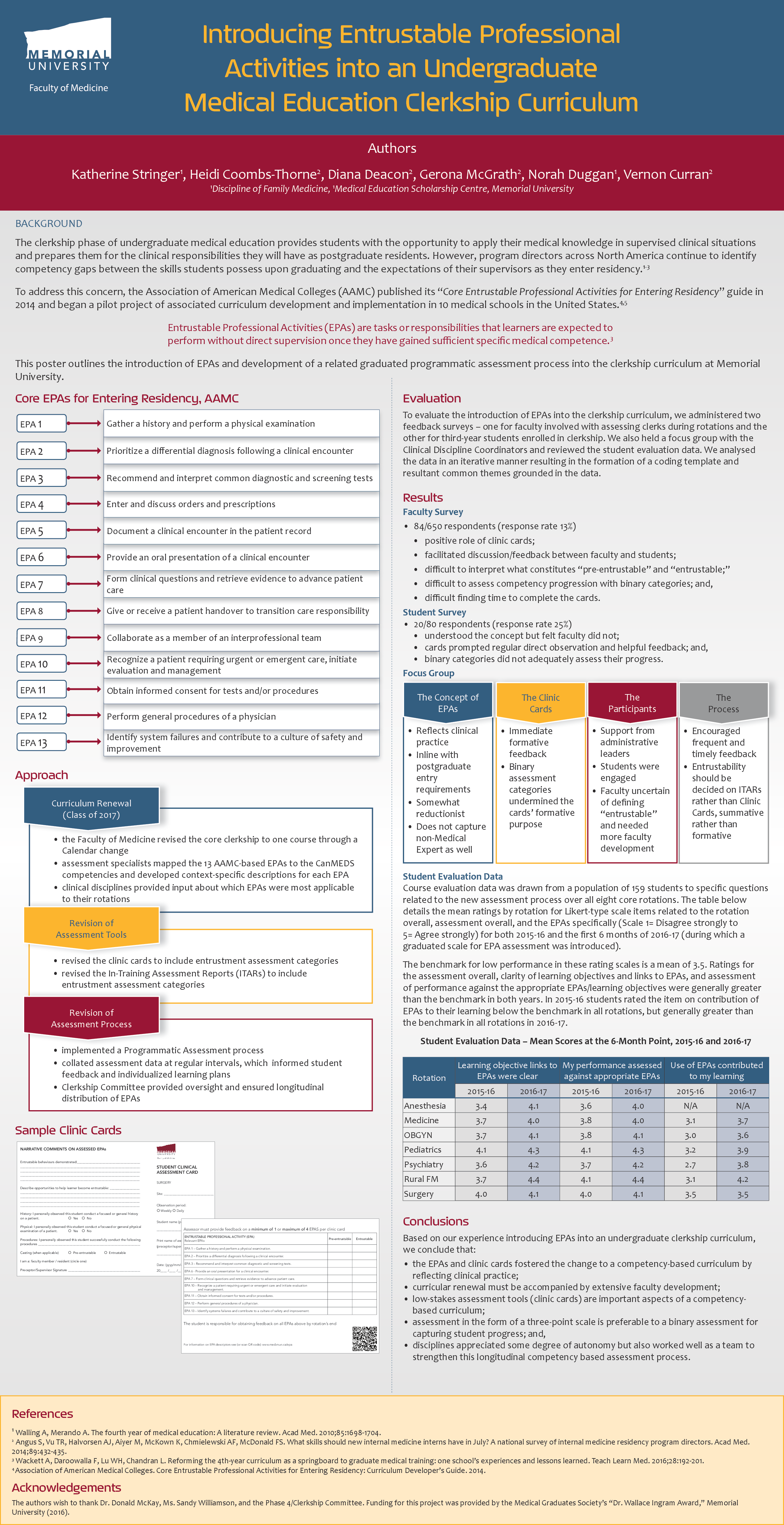
Purpose: In 2015, the Faculty of Medicine at Memorial University introduced Entrustable Professional Activities (EPAs) into the undergraduate medical education clerkship curriculum. EPAs are tasks or responsibilities that learners are expected to perform without direct supervision, once they have gained sufficient specific competence. Our introduction of EPAs included the 13 EPAs identified by the American Association of Medical Colleges (AAMC) in 2014. To introduce EPAs into clerkship, assessment specialists mapped the 13 EPAs identified by the AAMC to the CanMEDS competencies and undergraduate learning objectives. They then revised the clerkship assessment tools to reflect the language of EPAs and created new clinic cards for each rotation in clerkship. The cards contained EPAs-specific assessment statements that were appropriate for each rotation. They provided educators with two assessment options for gauging student performance: “entrustable” and “pre-entrustable,” and also included sections for qualitative feedback. They were primarily used for formative assessment but also informed the In-Training Assessment Reports for summative assessment. This project outlines and evaluates this process of introducing EPAs into the clerkship curriculum.
Methods: To evaluate this introduction of EPAs into clerkship, the research team held a focus group with the Clinical Discipline Coordinators and administered two surveys: one for faculty involved with assessing clerks during rotations and the other for third-year students enrolled in clerkship (Phase 4, Class of 2017). Data also included course evaluation results.
Results: All data-collection methods identified benefits and challenges related to the introduction of EPAs into clerkship and the clinic cards assessment system. 74.7% of respondents to the faculty survey felt the EPAs accurately reflected the activities of students in the discipline and 62.8% felt the clinic cards were effective for capturing student performance. The student evaluation data, survey results, and focus group results agreed that the clinic cards improved formative feedback for students. However, the binary nature of the cards (entrustable vs pre-entrustable) was problematic for both faculty and students and has since been changed to three categories to more easily highlight progress. Students and faculty also agreed that the concept of EPAs and the clinic cards were not well understood by faculty, resident preceptors, or students.
Conclusions: Our analysis indicates that EPAs can be successfully introduced into undergraduate medical education during clerkship. Such an introduction requires the mapping of EPAs to the CanMEDS competencies and undergraduate learning objectives, the adaptation of existing assessment tools to reflect the language of EPAs, and the creation of a new EPAs-specific assessment tool – the clinic card. This presentation will provide insight into introducing and assessing EPAs in clerkship and can inform similar initiatives in undergraduate medical education.