
Abstract
Context
Errors in healthcare cause significant patient morbidity and mortality.Inadequate teamwork and communication can result in serious consequences for patient care.The Royal College of Paediatrics and Child Health’s “Why Children Die” report demonstrated preventable factors in 26% of child mortality cases reviewed. Common factors included poor communication skills and poor situational awareness. Level one neonatal units need to maintain skill and knowledge bases for common neonatal emergencies despite limited exposure, including preparing critically ill neonates for transfer to tertiary units. Simulation can provide an important platform for maintaining these skills in the multidisciplinary team.
Description
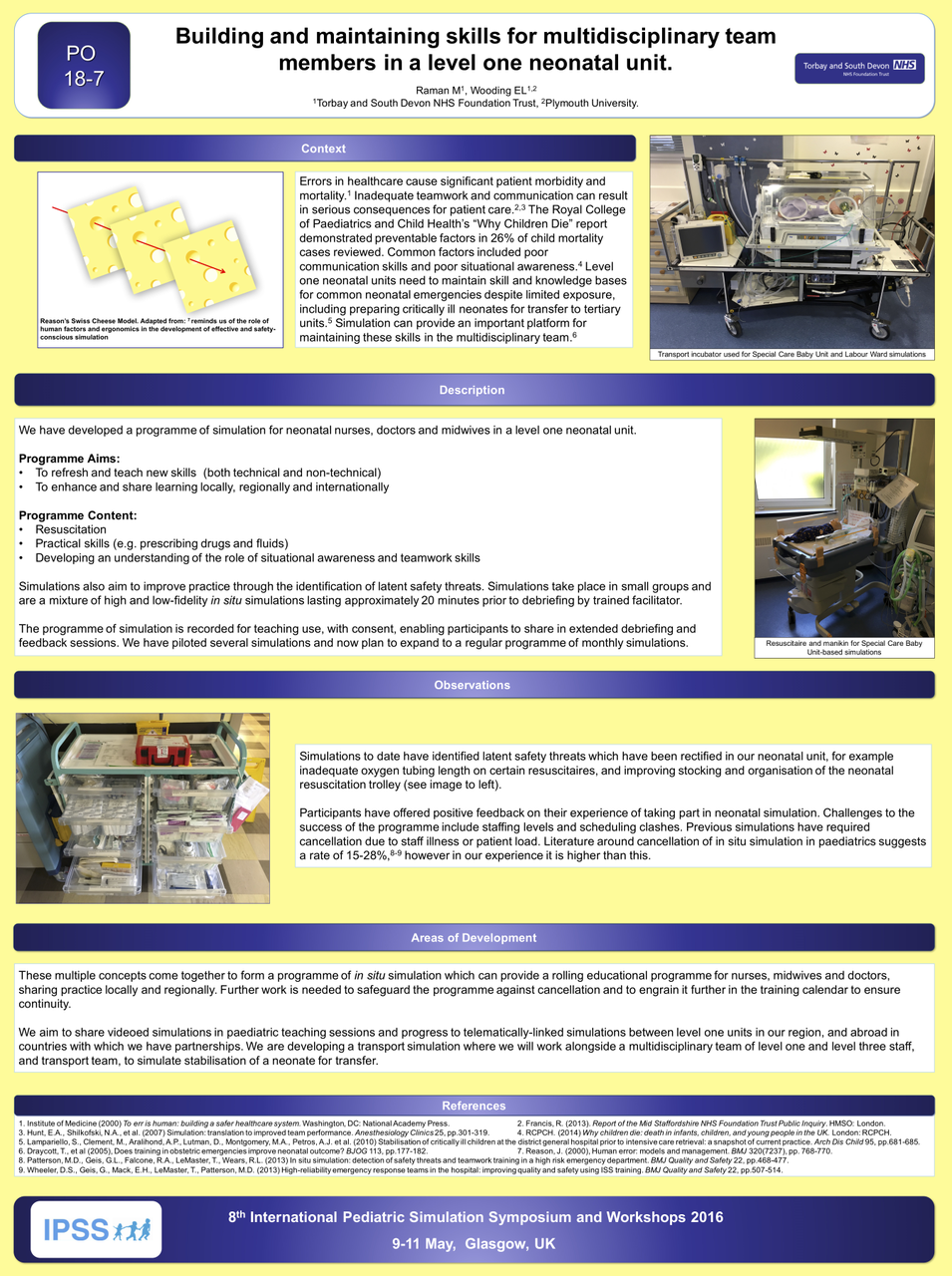
We have developed a programme of simulation for neonatal nurses and doctors in a level one neonatal unit which aims to refresh and teach new skills, both technical and non-technical, to enhance and share learning. The programme incorporates resuscitation, practical skills, such as prescribing drugs and fluids and developing situational awareness and teamwork skills. Simulations also aim to improve practice through the identification of latent safety threats. Simulations take place in small groups and are a mixture of high and low-fidelity in situ simulations lasting approximately 20 minutes prior to debriefing by trained facilitator.
The programme of simulation is recorded for use as a teaching tool, where consent is given. This enables participants to share in extended debriefing and feedback sessions. It is our aim to share videoed simulations in paediatric teaching sessions, with consent, and progress to telematically-linked simulations between level one units in our region. We are also developing a transport simulation where we will work alongside a multidisciplinary team of level one and level three staff, and transport team, to simulate stabilisation of a neonate for transfer. We have piloted several simulations and now plan to expand to a regular programme of monthly simulations.
Observations
Simulations to date have identified latent safety threats which have been rectified in our neonatal unit, for example inadequate oxygen tubing length on certain resuscitaires. Participants have offered positive feedback on their experience of taking part in neonatal simulation. Challenges to the success of the programme include staffing levels and scheduling clashes. Previous simulations have required cancellation due to staff illness or patient load. Literature around cancellation of in situ simulation in paediatrics suggests a rate of 15-28%, however in our experience it is higher than this.
Discussion
These multiple concepts come together to form a programme of in situ simulation which can provide a rolling educational programme for nurses and doctors, sharing practice locally and regionally. Further work is needed to safeguard the programme against cancellation and to engrain it further in the training calendar to ensure continuity.




