Abstract
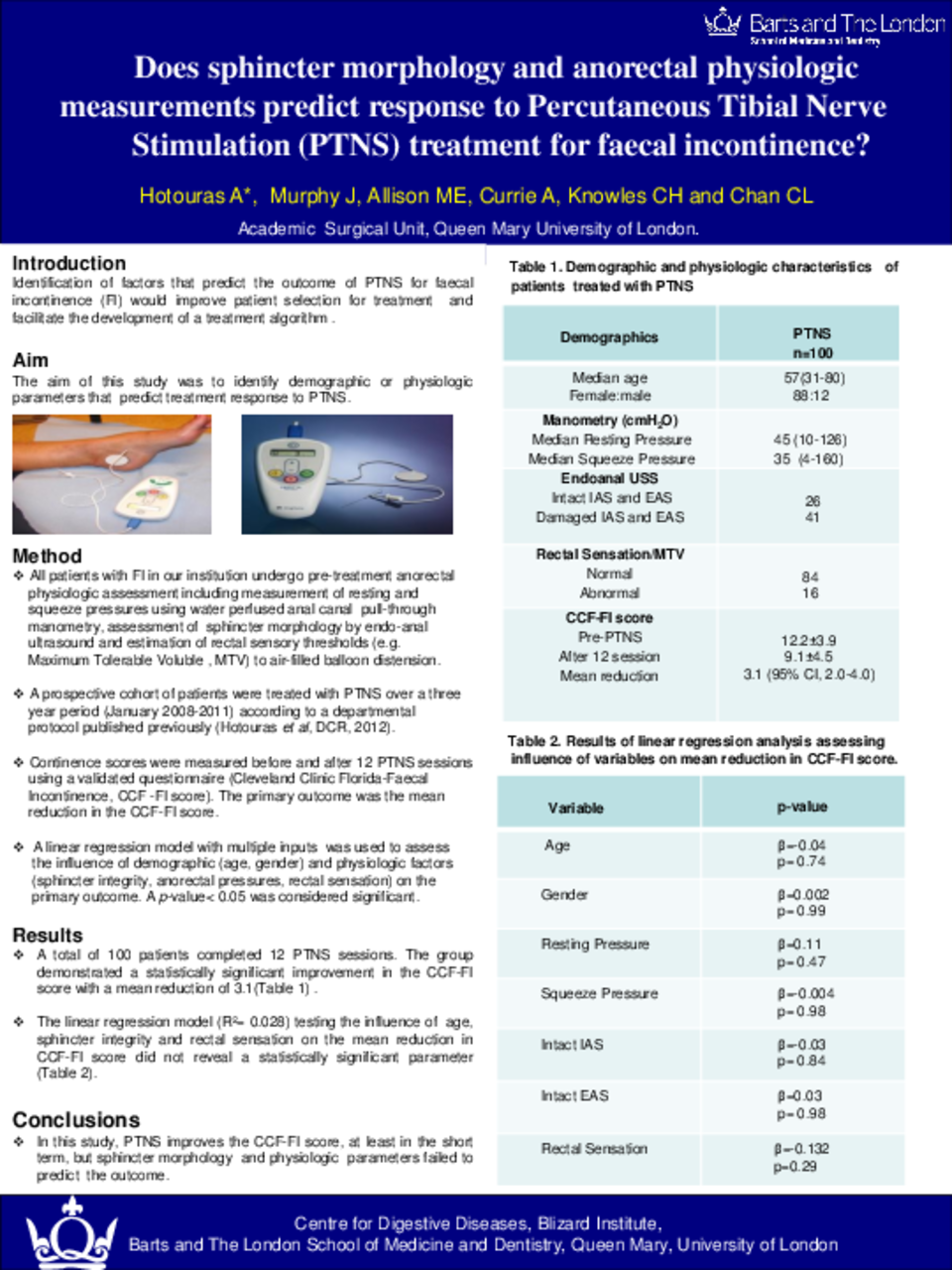
Background: Identification of factors that predict the outcome of PTNS for faecal incontinence (FI) would improve patient selection for treatment. We aimed to establish factors that may predict treatment response to PTNS.
Methods: Patients with FI underwent anorectal physiology including resting and squeeze pressures, rectal sensation and trans-anal ultrasound scan prior to PTNS. The difference in "Cleveland Clinic Florida-Faecal incontinence (CCF-FI) score (post-12 PTNS sessions - pre-PTNS) was calculated to measure treatment response. The influence of patient demographics (age, gender), anorectal physiology(rectal sensation, sphincter pressures), and sphincter morphology to predict the clinical outcome was tested using a linear regression model (p<0.05, significant).
Results: 100 patients (88-females) with FI (median age-57+13.6) underwent PTNS. Twenty-six patients had intact internal and external anal sphincter and 41 had sphincter compromise. The median resting and squeeze pressures were 45.5(10.0-126.0cmH2O) and 35.5(4.0-160.0cmH2O) respectively. Rectal sensation was normal in 84 and abnormal in 16 patients. The overall mean reduction in CCF-FI was 3.0 (95% CI 2.0-4.0). A linear regression model (R2 0.028) with multiple inputs did not reveal any significance for any of the predictors [(age (β=-0.04, p=0.74), gender (β=0.002, p=0.99), rectal sensation (β=-0.132, p=0.29), resting pressure (β=0.11, p=0.47), squeeze pressure (β=-0.004, p=0.98), intact IAS (β=-0.03, p=0.84) and intact EAS(β=0.003,p=0.98)] studied.
Conclusions: In this study of 100 faecal incontinence patients, PTNS improved faecal incontinence scores demonstrating patient benefits. However, sphincter morphology or physiological parameters failed to predict the response to treatment following PTNS.