Abstract
Purpose
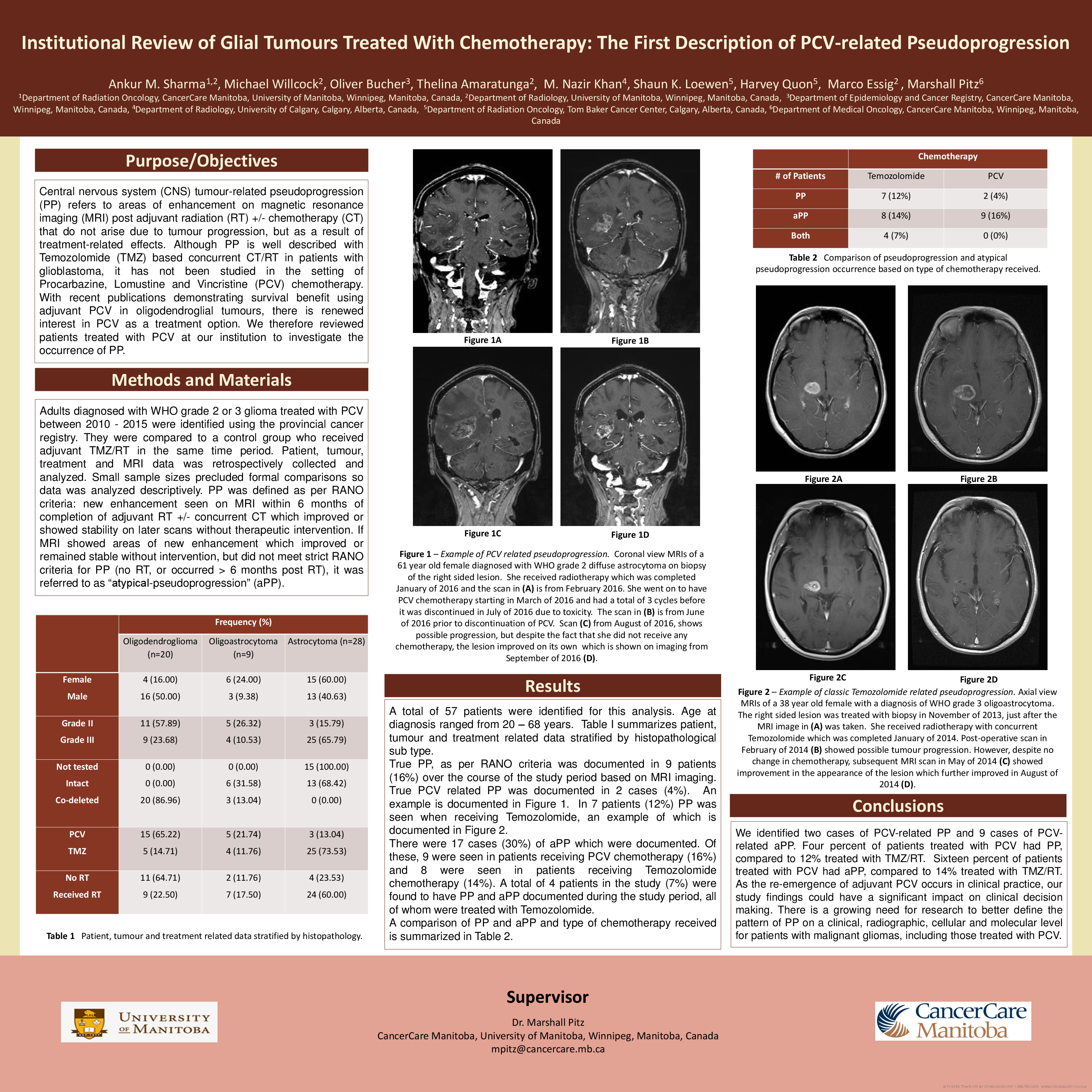
Central nervous system (CNS) tumour-related pseudoprogression (PP) refers to areas of enhancement on magnetic resonance imaging (MRI) post adjuvant radiation (RT) +/- chemotherapy (CT) that do not arise due to tumour progression, but as a result of treatment-related effects. Although PP is well described with Temozolomide (TMZ) based concurrent CT/RT in patients with glioblastoma, it has not been studied in the setting of Procarbazine, Lomustine and Vincristine (PCV). With recent publications demonstrating survival benefit using adjuvant PCV in low grade oligodendroglioma, there is renewed interest in PCV as a treatment option. We therefore reviewed patients treated with PCV at our institution to investigate the occurrence of PP.
Methods
Adults diagnosed with WHO grade 2 or 3 glioma treated with PCV between 2010 - 2015 were identified using the provincial cancer registry. They were compared to a control group who received adjuvant TMZ/RT in the same time period. Patient, tumour, treatment and MRI data was retrospectively collected and analyzed. Small sample sizes precluded formal comparisons so data was analyzed descriptively. PP was defined as per RANO criteria: new enhancement seen on MRI within 6 months of completion of adjuvant RT +/- concurrent CT which improved or showed stability on later scans without therapeutic intervention. If MRI showed areas of new enhancement which improved or remained stable without intervention, but did not meet strict criteria for PP (no RT, or occurred > 6 months post RT), it was referred to as “Pseudo-pseudoprogression” (PPP).
Results
Fifty-seven patients were identified. Age at diagnosis ranged from 20-68. Twenty (35%) had oligodendroglioma, 28 (49%) had astrocytoma and 9 (16%) had oligoastrocytoma.
For oligodendroglioma patients, 80% were male, 55% had WHO grade 2 tumours, 100% were 1p19q co-deleted, 75% received PCV and 45% got RT.
For astrocytoma patients, 46% were male, 11% had WHO grade 2 tumours, 0% were 1p19q co-deleted, 11% received PCV and 93% got RT.
For oligoastrocytoma patients, 33% were male, 56% had WHO grade 2 tumours, 33% were 1p19q co-deleted, 56% received PCV and 78% got RT.
Nine (16%) patients were identified as having PP on MRI. Seven (12%) were seen in cases treated using TMZ and 2 (4%) were seen in cases using PCV. Seventeen (30%) patients had PPP. Eight (14%) were treated with TMZ, 9 (16%) were treated with PCV. Four (7%) patients had both PP and PPP seen on MRI.
Conclusions
We describe two cases of PCV-related PP and 9 cases of PCV-related PPP. Four percent of patients treated with PCV had PP, compared to 12% treated with TMZ/RT. Sixteen percent of patients treated with PCV had PPP, compared to 14% treated with TMZ/RT. As the re-emergence of adjuvant PCV occurs in clinical practice, our study findings could have a significant impact on clinical decision making. There is a continuing need for research to better define the rate at which PP occurs in CNS patients treated with PCV.