Abstract
Introduction
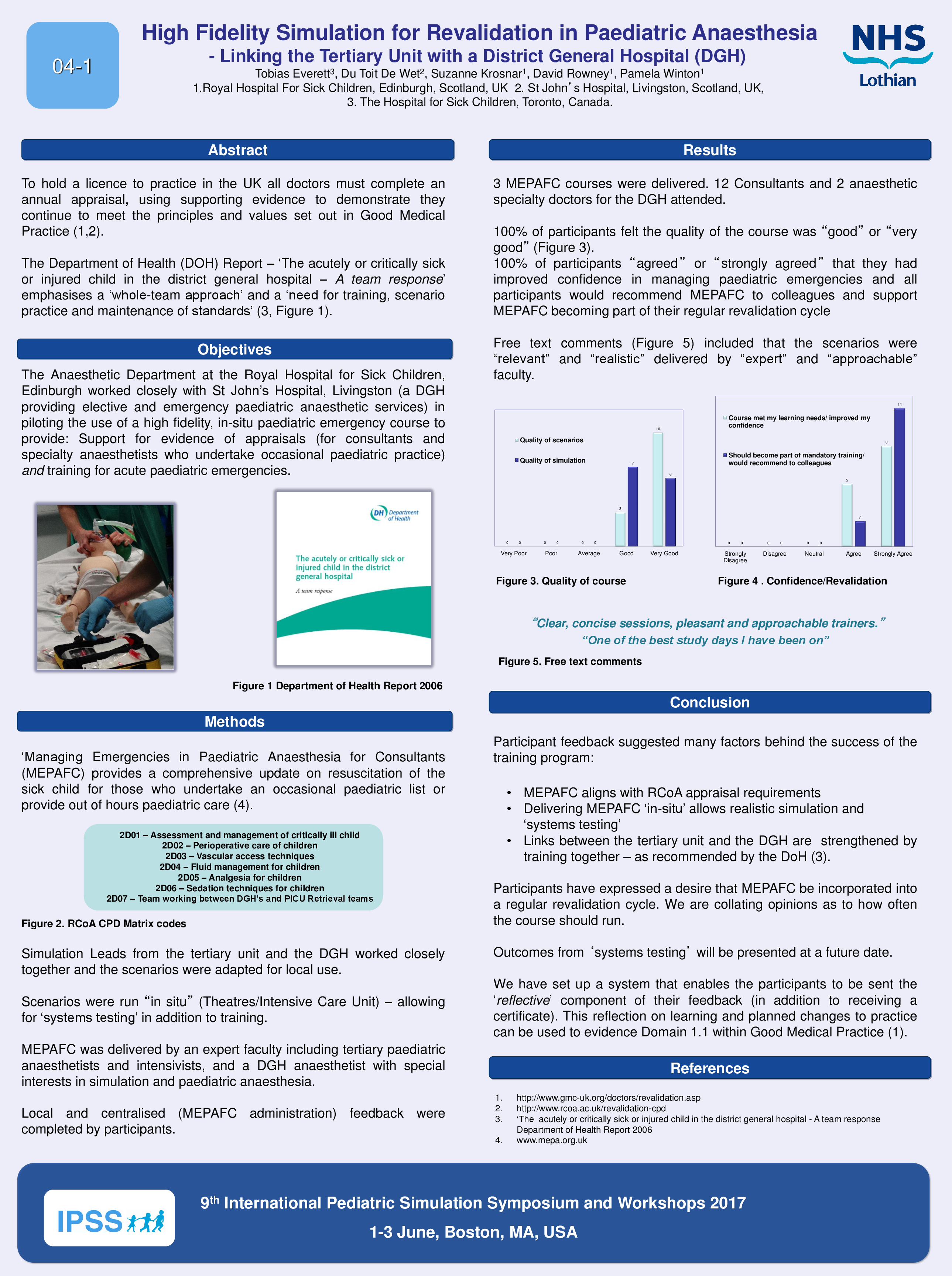
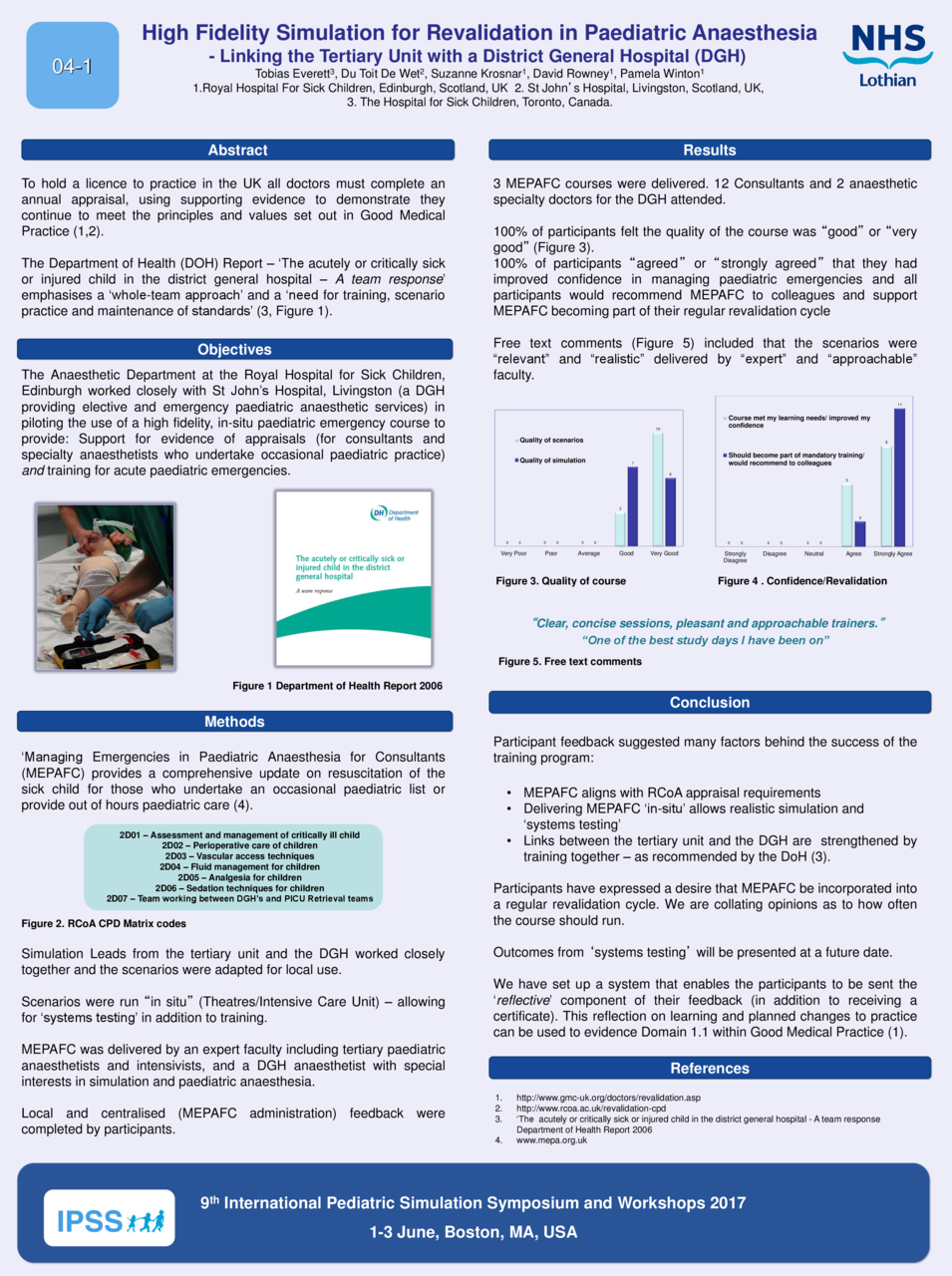
To hold a licence to practice in the UK all doctors must complete annual Appraisal, using supporting evidence to demonstrate they continue to meet the principles and values set out in Good Medical Practice (1,2).
The UK Department of Health Report – ‘The acutely or critically sick or injured child in the district general hospital - A team response’ emphasises a ‘whole-team approach’ and a ‘need for training, scenario practice and maintenance of standards’ (3).
The Anaesthetic Department at the Royal Hospital for Sick Children in Edinburgh worked closely with St John’s Hospital, Livingston, a District General Hospital (DGH) providing elective and emergency paediatric anaesthetic services, in piloting the use of a high fidelity, 'in-situ' paediatric emergency course to provide: support for evidence for Appraisal (for Consultants and non-career grade anaesthetists who undertake occasional paediatric practice) and training for acute paediatric emergencies.
‘Managing Emergencies in Paediatric Anaesthesia for Consultants’ (MEPA FC) provides a comprehensive update in resuscitation of the sick child for those who undertake an occasional paediatric list or provide out of hours paediatric care. The course covers all aspects of paediatric codes recommended in the Royal College of Anaesthetists (RCoA) UK Level 2 matrix (2,4).
Methods
Simulation Leads from the tertiary unit and DGH worked closely together in the development and delivery of the course. Scenarios were adapted for local use.
Scenarios were run ‘in-situ’ (Theatres/Intensive Care Unit) - allowing for ‘systems testing’ in addition to training.
Results
3 MEPA FC courses were delivered. 12 Consultants and 2 non career grade doctors from the DGH attended. Faculty included tertiary unit paediatric anaesthetists/intensivists and a DGH anaesthetist with an interest in paediatric anaesthesia.
100% of participants “agreed” or “strongly agreed” that they had improved confidence in managing paediatric emergencies. Free-text comments stated that the scenarios were “relevant” and “realistic” delivered by “expert” and “approachable” trainers. 100% of participants thought the training would positively affect patient safety and 100% of participants would recommend the training to colleagues.
Discussion
Participant feedback suggested many factors behind the success of this training programme:
- MEPA FC aligns with RCoA appraisal requirements.
- Running MEPA FC in-situ allows realistic simulation and ‘systems testing’.
- Links between the tertiary unit and the DGH are strengthened by training together.
Future work
Participants have expressed a desire that MEPA FC be incorporated into a regular revalidation cycle. The reflective component of the centralised feedback is used for evidence for Revalidation in addition to evidence of attendance. Outcomes from ‘systems testing’ will be presented at a future date.
References:
1) http://www.gmc-uk.org/doctors/revalidation.asp
2) http://www.rcoa.ac.uk/revalidation-cpd
3) ‘The acutely or critically sick or injured child in the district general hospital A team response Department of Health Report 2006.
4) https://mepa.org.uk/about-mepa/mepa-fc