Abstract
Abstract IPSSW 2017 1-3 June, Boston
Category: Innovation
Turning the ship of worries: Simulating future pediatric care in preparation for a hospital move
Authors: Margaretha Lannge MD*, Satu Selling RN, Maryann Florbrant RN Msc, Kiku Pukk Härenstam MD, PhD*
All from the pediatric Centre for Advanced Simulation and Training, Karolinska University hospital (pCAMST), Stockholm
Context: Starting from September 2016, pCAMST was commissioned by the chief medical officers to run simulations with all the care units at the children’s hospital and the department of thoracic in preparation for the move of all departments to a newly constructed hospital building. The new building and wards have a very different layout than our old building and all units will be challenges in redesigning their daily work practices. In the same time organization shifted from traditional clinics to theme based care.
The aim was twofold- to test the new environments and equipment so that changes could be made and errors corrected before the move but also to provide staff with the opportunity to acquaint themselves with the new facility and turn worries into curiosity. Previous studies have shown the potential of simulations to assess workload as well as illuminate latent safety threats in existing and new healthcare environments1,2. This presentation shares insights into how resource simulations can be designed and used on a large scale to prepare staff and managers before a hospital move.
Description: We used a collaborative process for designing the simulations for each unit. A team from CAMST met with managers and staff from each unit and identified key processes and procedures for each unit. They also identified common risk situations that the staff were anxious about and wanted to test in the new environment
Each day started with a pre-brief introducing the instructors, the unit and the pedagogic model used in simulation. We then ran 3-4 scenarios, some process simulations where the teams would test normal work-practices. Other scenarios were procedures such as surgical or radiological procedures. Each day we also ran 1-2 scenarios where a previously stable patient deteriorated and the situation escalated into an emergency. In these scenarios we also tested the new telephone, emergency signaling systems and emergency equipment. Problems and latent safety threats discovered were documented in a risk assessment matrix. The documentation was feed back to the clinical and supportive units as well as to the managers in charge.
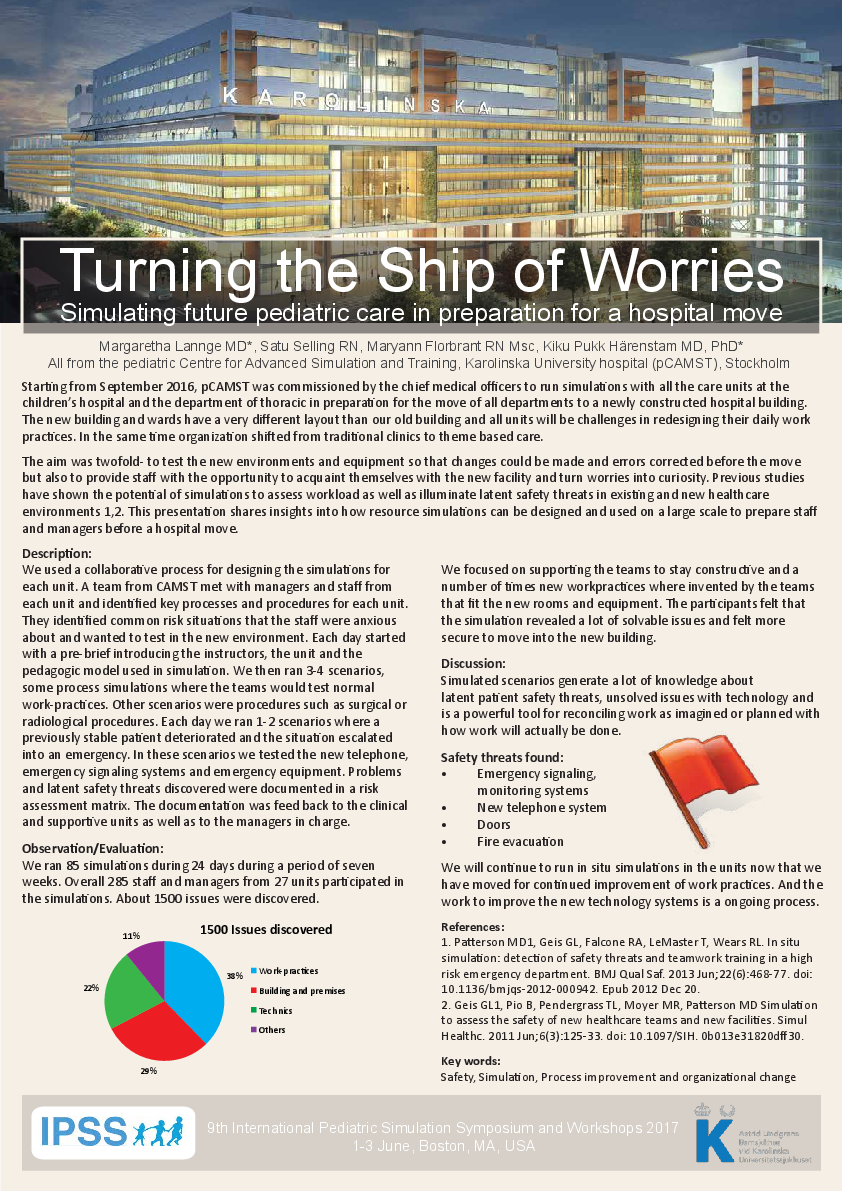
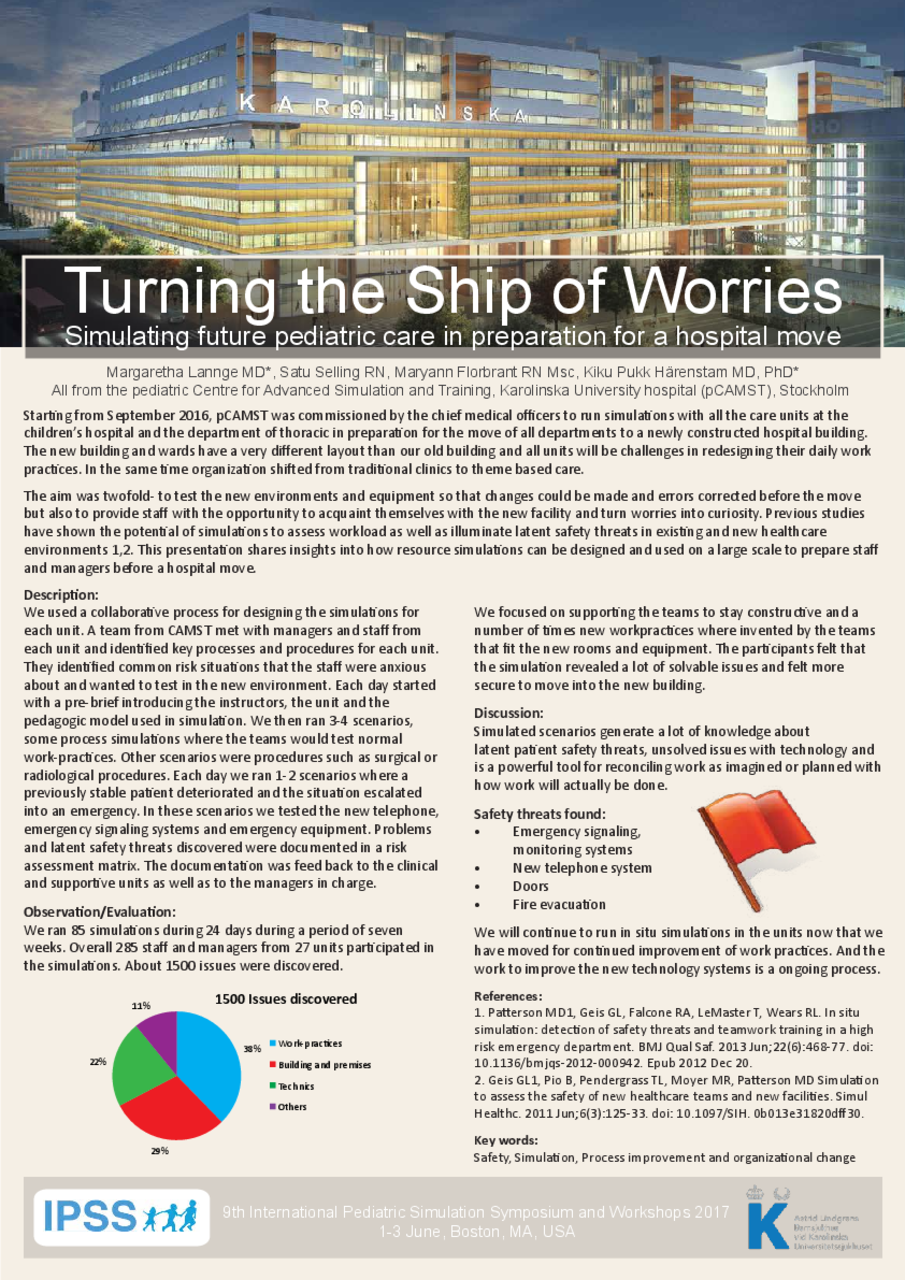
Observation/Evaluation: We ran 85 simulations during 24 days. Overall 285 staff and managers from 27 units participated in the simulations. Over 1499 issues were discovered. We focused on supporting the teams to stay constructive and a number of times new workpractices where invented by the teams that fit the new rooms and equipment.
The participants felt that the simulation revealed a lot of solvable issues and felt more secure to move into the new building.
Discussion: Simulated scenarios generate a lot of knowledge about latent patient safety threats, unsolved issues with technology and is a powerful tool for reconciling work as imagined or planned with how work will actually be done. We will continue to run in situ simulations in the units now that we have moved for continued improvement of work practices.