A Simulation Course Focusing on Forensic Evidence Collection Improves Pediatric Knowledge and Standardizes Curriculum for Child Abuse
Abstract
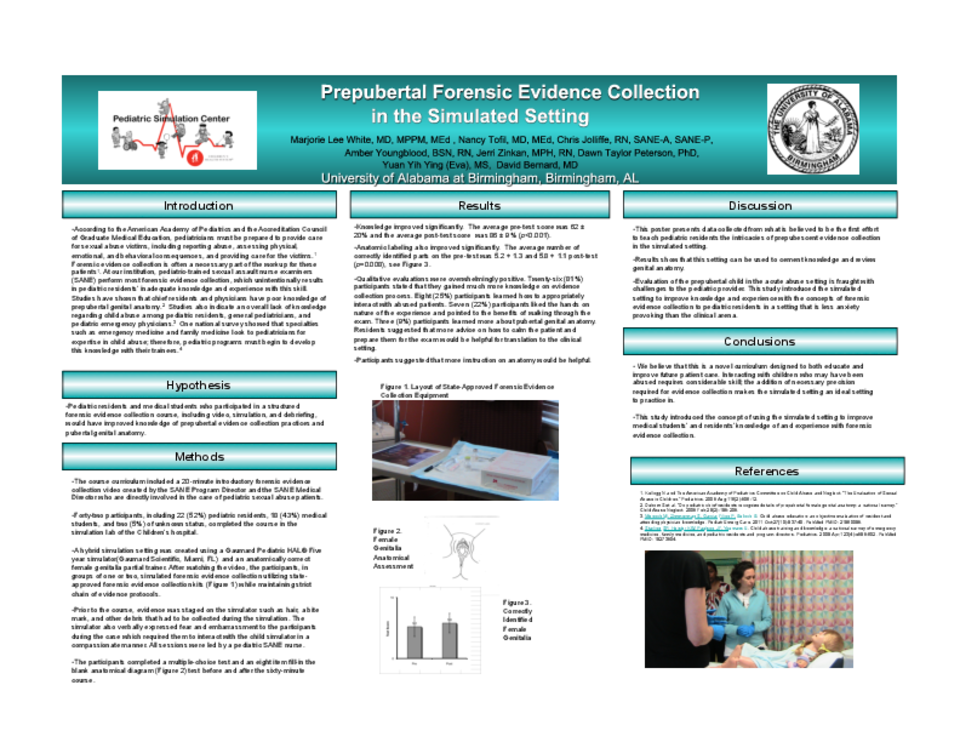
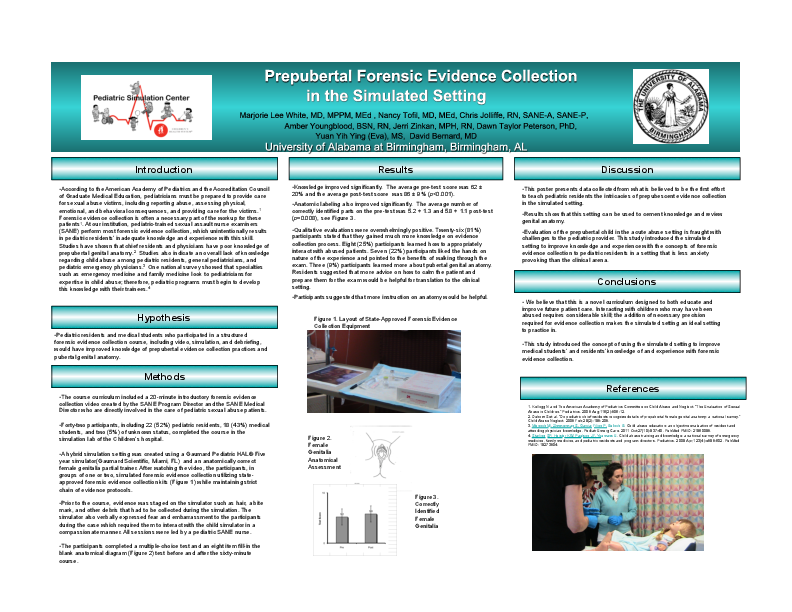
According the American Academy of Pediatrics, pediatricians must be prepared to provide care for sexual abuse victims, including reporting sexual abuse, assessing physical, emotional and behavioral consequences of the abuse, and providing care for the victims. Forensic evidence collection is often necessary as part of the workup. At our institution, pediatric-trained sexual assault nurse examiners (SANE) perform most forensic evidence collection, which unintentionally results in pediatric residents’ inadequate knowledge and experience with forensic evidence collection in children. In addition, studies have shown that chief residents and physicians have poor knowledge of prepubertal genital anatomy. Our hypothesis is that after participation in specifically designed didactic course of simulation, pediatric residents and medical students would have improved knowledge of prepubertal evidence collection practices and pubertal genital anatomy. In this study, there are 42 total participants including 22 (52%) pediatric residents, 18 (43%) medical students, and 2 (5%) of unknown resident v.s. student status. The method included a 20-minute introductory forensic evidence collection video created by the SANE Program Director and physician expert involved with pediatric sexual abuse. A hybrid simulation setting was created using a Gaumard Pediatric HAL® Five year (Gaumard Scientific, Miami, FL) simulator and an anatomically correct female genitalia partial trainer. Evidence is staged on the simulator such as hair, a bite mark and other debris that is required to be collected. In addition, the simulator talks to participants during the case expressing fear and embarrassment. Participants must interact with the child in a compassionate manner. All participants watch the video and then participate in groups of 1-2 on the simulated forensic evidence collection experience utilizing the state-approved forensic evidence collection kits. All sessions are led by a SANE nurse and a pediatric emergency medicine physician with expertise in sexual abuse. All participants complete a nine multiple-choice question and an eight fill-in the blank anatomical diagram test before and after the sixty-minute course. The average pre-test score was 62% +- 20% and the average post-test score was 86% +- 9% (p<0.001). Anatomic labeling also improved; the average number of correctly identified parts on the pre-test was 5.2 + 1.3 and 5.8 + 1.1 post-test (p=0.008). Qualitative evaluations were overwhelmingly positive. 26 (81%) participants stated that they gained much more knowledge on evidence collection process. 8 (25%) participants learned how to appropriately interact with abused patients. 7 (22%) participants liked the hands on nature of the experience and pointed to the benefits of walking through the exam. 3 (9%) participants learned more about pubertal genital anatomy. Participants suggested that more anatomy would be helpful. In conclusion, the improved post-test scores and participants’ evaluations showed that the simulation course improves knowledge of forensic collection process, pubertal genital anatomy and how to handle abused victims. Evaluation of the prepubertal child in the acute abuse setting is fraught with challenges to pediatricians. This study introduced the simulated setting to improve knowledge and experience with the concepts of forensic evidence collection to residents and medical students in a less anxiety provoking setting.
Related articles