Outcomes in Patients Receiving Left Ventricular Assist Devices as Bridge to Decision
Abstract
Outcomes in patients who receive left ventricular assist devices (LVAD) as bridge to decision (BTD) are poorly characterized; therefore we examined our institutional LVAD experience to better understand the clinical course of these patients.
Traditionally, there have been two subsets of LVAD patients with end-stage heart failure – destination therapy (DT) and bridge to transplant (BTT). Recently a third subset has emerged: bridge to decision (BTD). These are patients whose transplant candidacy is unclear at the time of implant.
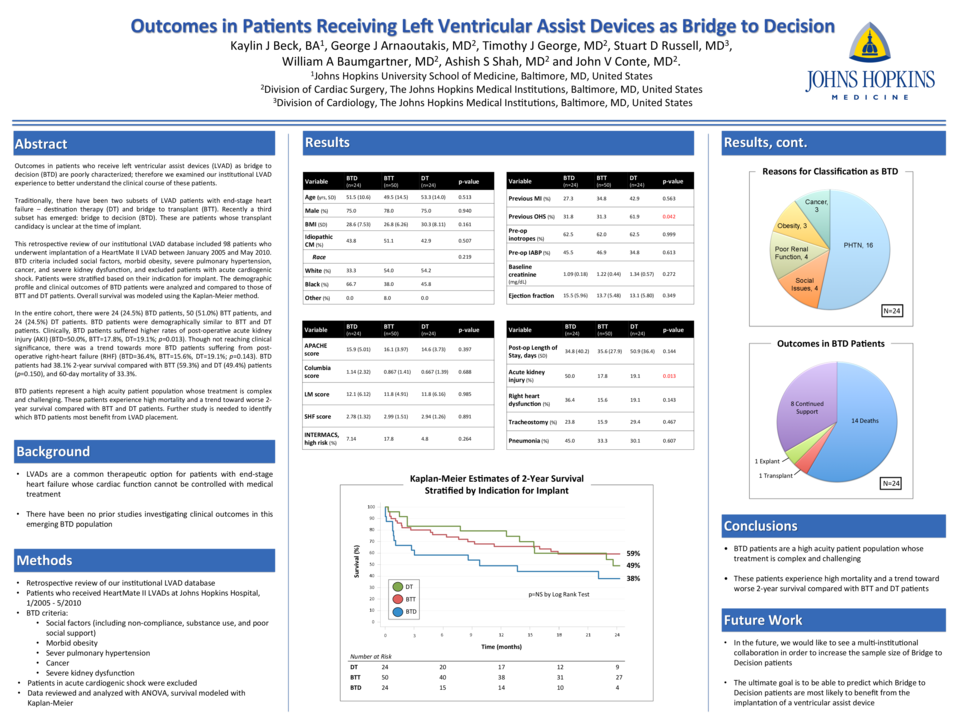
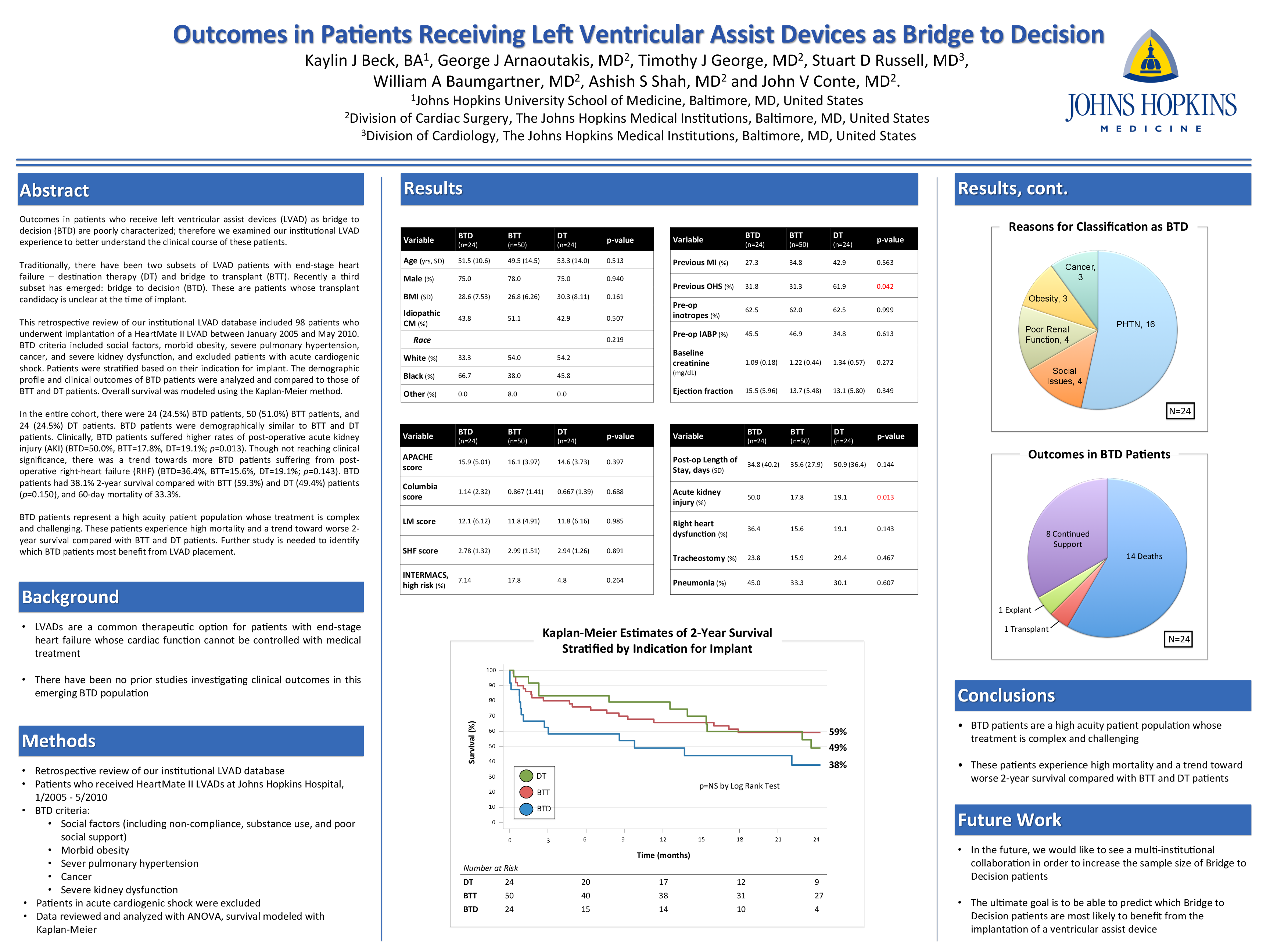
This retrospective review of our institutional LVAD database included 98 patients who underwent implantation of a HeartMate II LVAD between January 2005 and May 2010. BTD criteria included social factors, morbid obesity, severe pulmonary hypertension, cancer, and severe kidney dysfunction, and excluded patients with acute cardiogenic shock. Patients were stratified based on their indication for implant. The demographic profile and clinical outcomes of BTD patients were analyzed and compared to those of BTT and DT patients. Overall survival was modeled using the Kaplan-Meier method.
In the entire cohort, there were 24 (24.5%) BTD patients, 50 (51.0%) BTT patients, and 24 (24.5%) DT patients. BTD patients were demographically similar to BTT and DT patients. Clinically, BTD patients suffered higher rates of post-operative acute kidney injury (AKI) (BTD=50.0%, BTT=17.8%, DT=19.1%; p=0.013). Though not reaching clinical significance, there was a trend towards more BTD patients suffering from post-operative right-heart failure (RHF) (BTD=36.4%, BTT=15.6%, DT=19.1%; p=0.143). BTD patients had 38.1% 2-year survival compared with BTT (59.3%) and DT (49.4%) patients (p=0.150), and 60-day mortality of 33.3%.
BTD patients represent a high acuity patient population whose treatment is complex and challenging. These patients experience high mortality and a trend toward worse 2-year survival compared with BTT and DT patients. Further study is needed to identify which BTD patients most benefit from LVAD placement.
Related articles