Abstract
Introduction
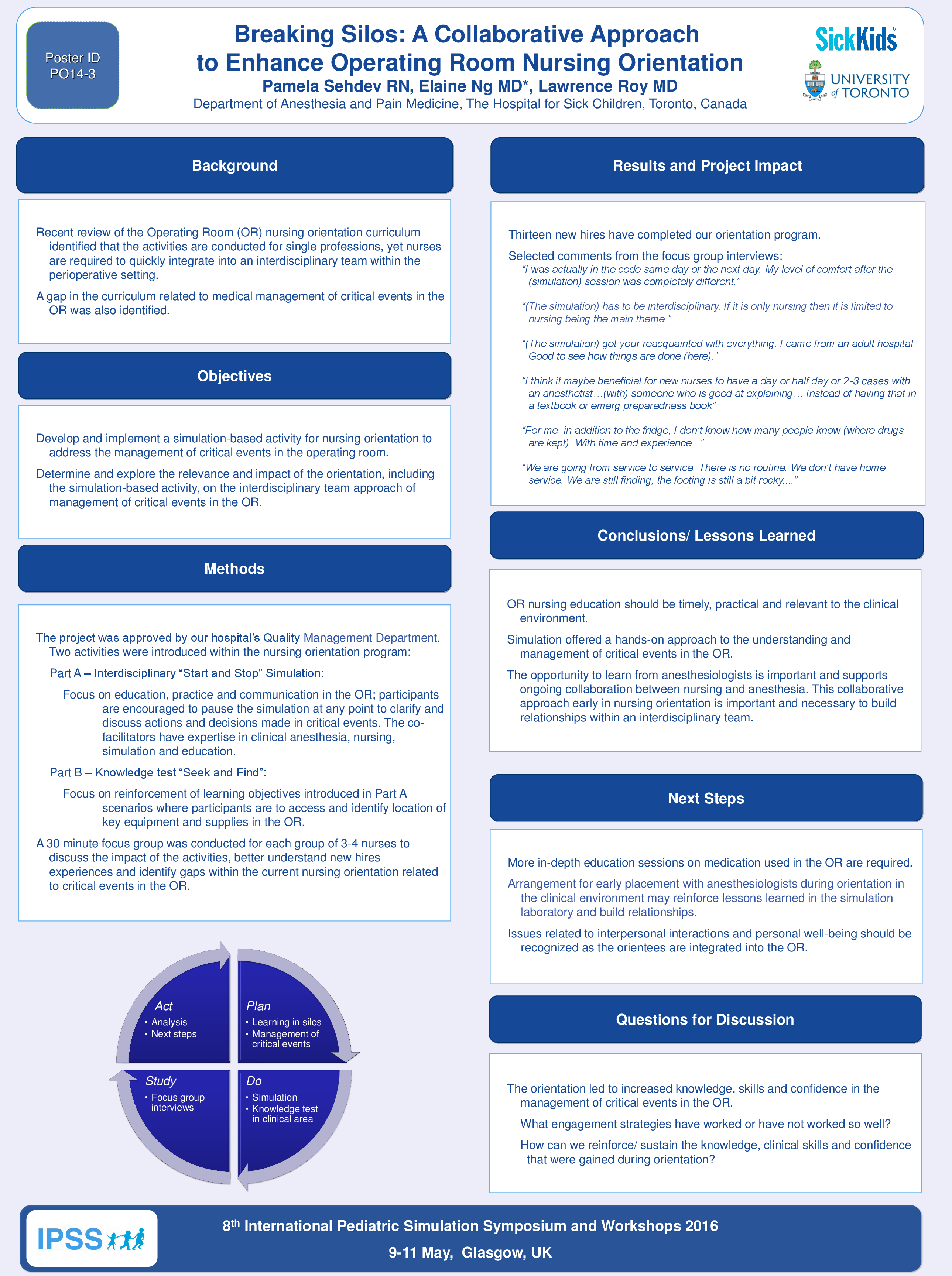
Recent review of the Operating Room (OR) nursing orientation curriculum identified that the activities are conducted for single professions, yet nurses are required to quickly integrate into an interdisciplinary team within the perioperative setting. A gap in the curriculum related to medical management of critical events in the OR was also identified.
The objective was to develop and implement a simulation-based activity for nursing orientation to address the management of critical events in the operating room. A second objective was to determine and explore the relevance and impact of the orientation, including the simulation-based activity, on the interdisciplinary team approach of management of critical events in the OR.
Methods
The project was approved by our hospital’s Quality Management Department. Two activities were introduced within the nursing orientation program:
Part A – Interdisciplinary “Start and Stop” Simulation: Focus on education, practice and communication in the OR; participants are encouraged to pause the simulation at any point to clarify and discuss actions and decisions made in critical events. The co-facilitators have expertise in clinical anesthesia, nursing, simulation and education.
Part B – Knowledge test “Seek and Find”: Focus on reinforcement of learning objectives introduced in Part A scenarios where participants are to access and identify location of key equipment and supplies in the OR.
A 30 minute focus group was conducted for each group of 3-4 nurses to discuss the impact of the activities, better understand new hires experiences and identify gaps within the current nursing orientation related to critical events in the OR.
Results
Thirteen new hires have completed our orientation program. Selected comments from the focus group interviews:
“I was actually in the code same day or the next day. My level of comfort after the (simulation) session was completely different.”
“(The simulation) has to be interdisciplinary. If it is only nursing then it is limited to nursing being the main theme.”
“(The simulation) got your reacquainted with everything. I came from an adult hospital. Good to see how things are done (here).”
“I think it maybe beneficial for new nurses to have a day or half day or 2-3 cases with an anesthetist…(with) someone who is good at explaining… Instead of having that in a textbook or emerg preparedness book”
“For me, in addition to the fridge, I don’t know how many people know (where drugs are kept). With time and experience...”
“We are going from service to service. There is no routine. We don’t have home service. We are still finding, the footing is still a bit rocky....”
Conclusions
OR nursing education should be timely, practical and relevant to the clinical environment. Simulation offered a hands-on approach to the understanding and management of critical events in the OR. The opportunity to learn from anesthesiologists is important and supports ongoing collaboration between nursing and anesthesia. This collaborative approach early in nursing orientation is important and necessary to build relationships within an interdisciplinary team.
Next steps include more in-depth education sessions on medication used in the OR. Arrangement for early placement with anesthesiologists during orientation in the clinical environment may reinforce lessons learned in the simulation laboratory and build relationships. Issues related to interpersonal interactions and personal well-being should be recognized as the orientees are integrated into the OR.