
Abstract
Background: In communities with high levels of social deprivation, there is a clear association with poorer health outcomes in children and young people. Public health outreach programmes can be very effective in improving health outcomes in paediatric populations.
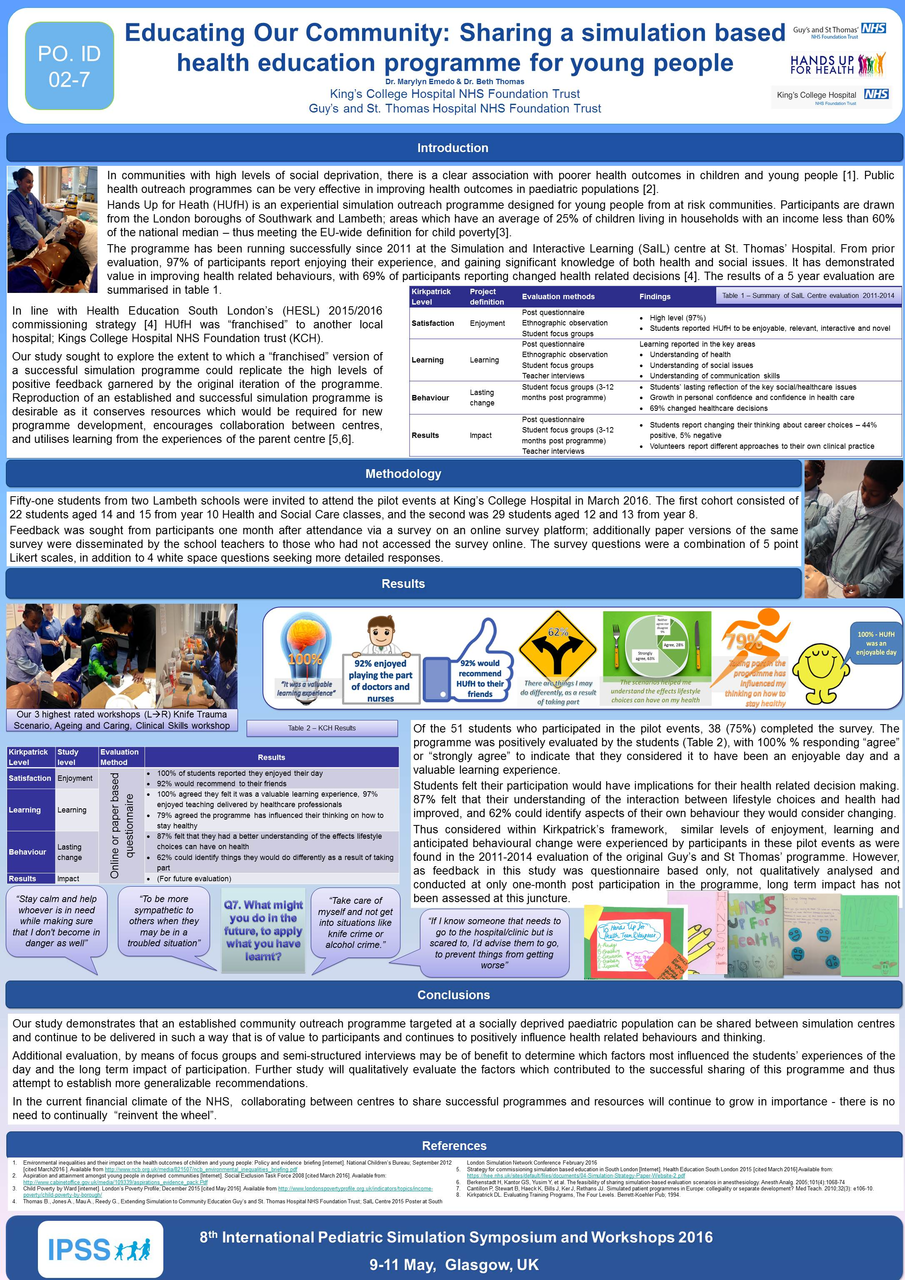
Hands Up for Heath (HUfH) is a simulation outreach programme designed for young people from at risk communities. The programme has been running successfully since 2011 at the Simulation and Interactive Learning (SAIL) centre at St. Thomas’ Hospital. From prior evaluations, 97% of participants report enjoying their experience, and gaining significant knowledge of both health and social issues.
In 2016 with funding from Health Education South London (HESL) in line with the 2015/2016 commissioning strategy HUfH was “franchised” to another local hospital; Kings College Hospital NHS Foundation trust (KCH).
Reproduction of an established and successful simulation programme is desirable as it conserves resources which would be required for new programme development, encourages collaboration between centres, and utilises learning from the experiences of the parent centre.
This study aims to determine the degree to which this programme’s successes can be replicated with dissemination to a different simulation centre, by means of evaluating the two pilot events held at KCH in March 2016.
Methodology: All students (n=51) who participated in the two pilot events at King’s College were invited to complete a questionnaire composed of both open-ended and closed questions the month after their experience. The content of the questionnaire is based on outcome data from a multi-modal study of the HUfH events held between 2011-2014. Kirkpatrick’s 4 level model is used as a framework for evaluation.
Results: Of the 51 students who participated in the pilot events, 38 (75%) completed the survey. The programme was positively evaluated by the students, with responses suggesting similar levels of enjoyment, learning and anticipated behavioural change as found in the 4-year evaluation of the original St Thomas’ programme.
Conclusion: This study demonstrates that an established community outreach programme targeted at a socially deprived paediatric population can be shared between simulation centres and continue to be delivered in such a way that is of value to participants and continues to positively influence health related thinking and behaviours.




